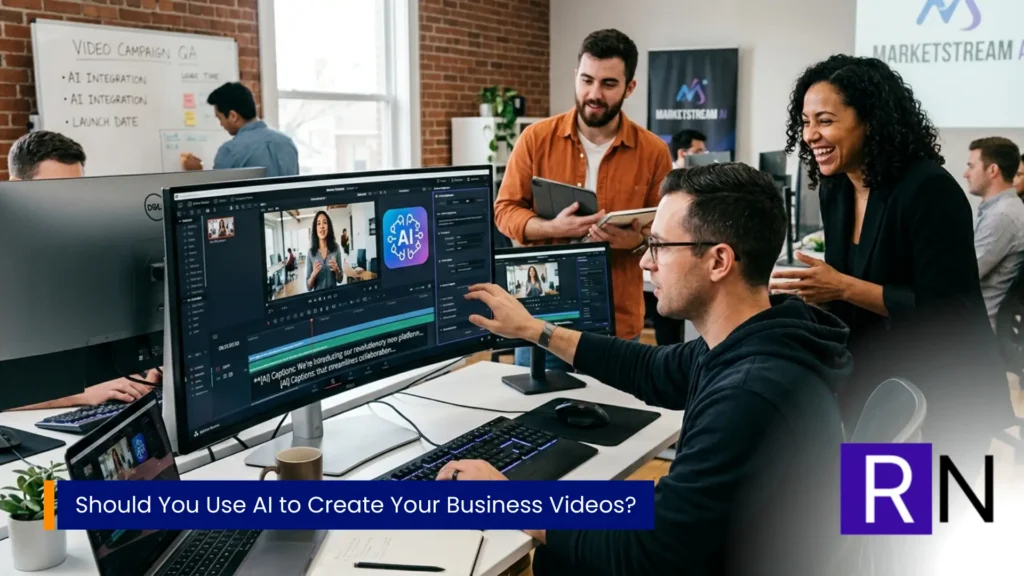
A year ago, “AI video” mostly meant uncanny-valley avatars and clips that fell apart after three seconds. That’s no longer the story. Heading into the second half of 2026, AI video tools have moved from novelty to infrastructure, and the businesses sitting on the sidelines are starting to look slow rather than cautious.
My short answer: yes, I’d recommend AI video for businesses. My longer answer is that it depends heavily on what you’re using it for, and getting that distinction right is the difference between a genuine competitive edge and a brand that quietly erodes its own trust.
The case for AI video is now backed by real numbers, not hype
The market growth alone tells you this isn’t a passing trend. Industry estimates put global AI video ad spend at roughly $9.1 billion in 2026, about 12% of all digital video advertising, with Asia-Pacific adoption growing even faster. On performance, the gap is widening too: AI-produced video ads are reportedly seeing view-through rates in the low 60% range, well ahead of traditional video ads in the high 40s, and personalized AI videos have shown notably higher click-through rates than generic ones.
For a consultancy like mine working with B2B clients, the practical benefits show up in three places:
1. Speed and iteration. The old video pipeline (script, shoot, edit, upload, repeat) could take weeks. AI tools compress that into hours, which matters enormously for A/B testing ad creative, localizing campaigns across markets, or turning a product listing into a working ad variant on short notice.
2. Cost reallocation, not just cost cutting. The real value isn’t just “cheaper video”; it’s freeing budget that used to go toward production crews and reallocating it toward media spend or testing more concepts. For small and mid-sized B2B businesses that could never justify a full video production budget, this is the difference between having a video strategy and not having one at all.
3. Volume for the channels that reward it. Short-form and social platforms are hungry for constant content, and AI is genuinely good at the 5-15 second clip, the product visualization, the localized variant, the internal update. This is the category where AI video has essentially solved the problem.
Where I’d pump the brakes
Here’s the part most “AI will change everything” posts skip over: AI video is not uniformly good at everything, and using it in the wrong place can actively hurt you.
The most important data point I came across is about trust. Research on video marketing found that a large majority of consumers say they trust videos featuring real people more than AI-generated content, and, more tellingly, a meaningful share of viewers who believe they’ve watched AI-generated video say it lowers their trust in the brand behind it. That’s not a minor aesthetic quibble. If your business sells on relationships (engineering, manufacturing, consulting, anything where a buyer needs to trust the people behind the product), a faceless avatar reciting your specs is not a substitute for your actual sales engineer explaining a tolerance on camera.
Lip-sync and talking-head quality is also still a genuine weak spot. Even in mid-2026, benchmark testing across leading text-to-video models found all of them struggle with reliable lip-sync on close-up talking heads. Text rendering inside generated video (signage, labels, on-screen documents) is another consistent failure point. So if your video needs a person to speak directly and convincingly to camera, or needs legible on-screen text, most current AI tools are still the wrong tool for that specific job.
There’s also a strategic risk in treating AI video as a content firehose rather than a content strategy. The tools are the easy part now; discipline is what’s scarce. Enterprises are reportedly running an average of three-plus different AI video tools simultaneously, stitching together a modular stack rather than relying on one platform to do everything. That’s a sign the category has matured, but it also means “just generate more videos” isn’t a strategy on its own. Without a clear answer to who the video is for, what it needs to achieve, and where it will live, AI just lets you produce noise faster.
My actual recommendation
Use AI video, but sort your content into two buckets first.
Bucket one, hand it to AI: product visualizations, ad variant testing, localized versions of existing campaigns, social/short-form content, internal updates, quick concept drafts, and anything where volume and speed matter more than a specific human face or voice.
Bucket two, keep it real: anything where your people, your facility, or your process is the message. Founder-led content, testimonials, plant-floor walkthroughs, anything where a buyer is evaluating whether to trust your team, film that for real. An AI avatar in a suit doesn’t convey the confidence of your actual quality manager standing next to actual equipment, and audiences increasingly can tell the difference and penalize brands for it.
For B2B businesses specifically (which is where most of my work sits), this split matters more than average. B2B buying decisions run on trust and specificity in a way consumer purchases often don’t. AI is brilliant for the top-of-funnel content that gets attention and the mid-funnel variants that keep testing cheap. It’s a weaker choice for the bottom-of-funnel moments where a prospect is deciding whether to trust you with a six or seven-figure contract.
So: recommend it, adopt it, build it into your stack. Just don’t let the ease of generating video talk you into replacing the parts of your brand that were never supposed to be automated in the first place.