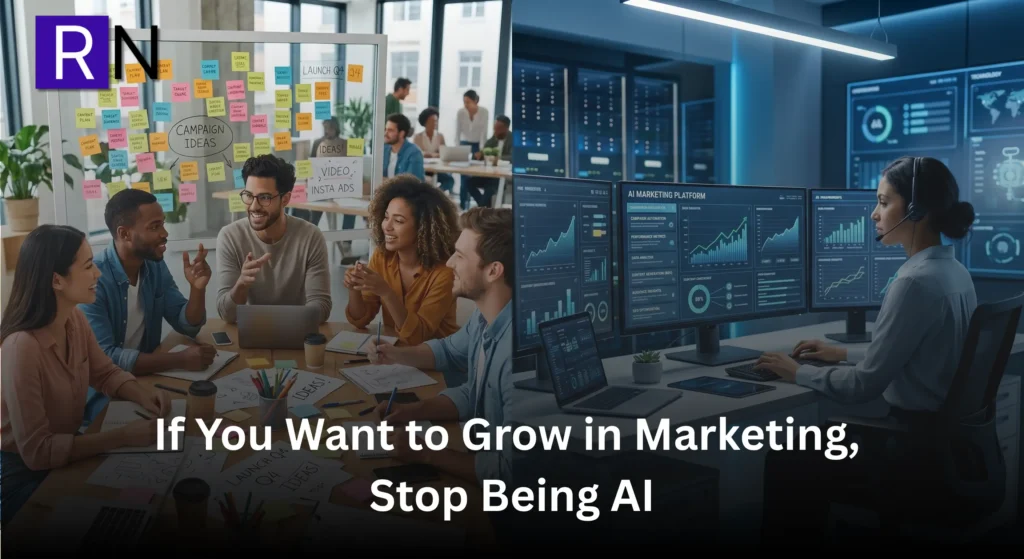
AI can write your copy, optimise your bids, and schedule your posts. The one thing it cannot do — and never will — is be genuinely, culturally, irreducibly human. That is now your most valuable professional asset.
Let me be honest with you: a significant chunk of the marketing tasks that occupied our weeks in 2020 are now being handled by machines in minutes. Ad copy variations. A/B test summaries. Basic SEO briefs. Email subject line generation. Competitor research digests. If it was templated, repeatable, and data-driven — there is now a tool doing it faster and cheaper than any human team.
This is not a warning. It is an accounting. Because once you accept that those tasks are gone, a clarifying question emerges: what, exactly, is the marketer’s job now?
The answer, increasingly backed by evidence, is this: the marketer’s job is to be undeniably human. And that turns out to be far harder — and far more valuable — than anything we’ve automated away.
I used to tell my team this long before ChatGPT was a thing: don’t be a robot. What I meant wasn’t about writing style. I meant — think. Understand what the customer actually needs, not just what they asked for. Bring ideas to the table. Notice what’s not working and fix it without being told. A robot executes instructions; a marketer understands context. Back then, the risk was people showing up and waiting to be pointed at a task. Now the risk is the same, just dressed differently — marketers who outsource their thinking to AI, prompt their way to an output, and call it done. The tool has changed. The failure mode hasn’t. Don’t be a robot. Don’t be AI. Be the person in the room who actually understands the customer.
The finding: The American Marketing Association’s 2026 Future Trends Report, compiled with input from over 30 senior marketing professionals, concluded that while AI will absorb most transactional marketing work, human creativity, cultural fluency, and authentic storytelling will become the primary differentiators for brands over the next five to ten years.
01. The Old Way Is Phasing Out — Not in the Future, Right Now
For decades, marketing was structured around execution capacity. The team with more people, more budget, and more production hours won. Content was a volume game. Reach was a spending game. Distribution was a relationships game. Scale was the moat.
That moat has been drained. A solo marketer with a $50/month AI stack can now produce what a five-person content team produced in 2018. And produce it faster. And publish it across more channels. The “execution capacity” model — more hands equals more output equals more results — is structurally obsolete.
What is replacing it is a model built around judgment, taste, and cultural intelligence. The question is no longer “can we produce this?” — the answer is always yes. The question is “should we? Does this actually mean something to the person reading it? Does it earn trust or erode it?”
“The brands that win in 2026 are not the ones using AI the most. They are the ones using AI to clear space for the things only humans can do.”
02. What “Human Creativity” Actually Means (It’s Not What You Think)
When people hear “creativity,” they often think of campaign concepting or visual design. That is part of it. But the creative edge that separates great marketers in an AI-saturated landscape is something more specific and more mundane-sounding: cultural fluency.
Cultural fluency means understanding why a particular joke lands with a particular audience in a particular moment. It means knowing that the tone that works in a LinkedIn post aimed at a 45-year-old IT director in Dubai is completely different from one aimed at a 28-year-old developer in Berlin. It means sensing when a brand should say nothing — when silence or restraint is the right move. It means recognising a trend early enough to ride it rather than chase it.
AI can approximate this with vast training data. It cannot truly inhabit it. A model trained on historical text patterns will always lag behind lived, present-tense cultural experience. The marketer who is deeply embedded in their audience’s world — who actually reads what they read, worries what they worry, laughs at what they laugh at — has signal that no model has yet.
03. Authentic Storytelling Is Not a Soft Skill. It Is a Revenue Driver.
Here is where the conversation often goes wrong. Marketers hear “authentic storytelling” and hear “brand values content” — the kind of fluffy, purpose-driven content that generates LinkedIn applause and zero pipeline. That is not what this trend is about.
Authentic storytelling, in its most commercially potent form, means being specific. Specificity is the thing AI consistently gets wrong. AI writes in the language of plausible generality. It produces content that sounds correct, reads smoothly, and says nothing that anyone would disagree with — which means nothing that anyone would remember or act on.
A B2B story that says “we help teams move faster” is AI content. A B2B story that says “our client’s QA lead used to dread Monday deploys. Now she’s the one pushing for them” is human content. The first is forgettable. The second creates a specific, recognisable moment that a prospect either sees themselves in — or doesn’t, which is also useful.
Specificity comes from real conversations with real customers, real time spent understanding what actually goes wrong in their workflows, real opinions about why certain solutions are better than others. That is the raw material of authentic marketing. And it is gathered in ways that require a human presence.
04. The Marketer You Need to Become
This is not a comfortable message if your current value proposition is execution speed. It is, however, a very good message if you are willing to upgrade. Here is what the shift looks like in practice:
- From content producer to content strategist. Let AI draft. Your job is to decide what is worth saying, who needs to hear it, and whether what came back actually sounds like a real person would say it.
- From channel manager to audience anthropologist. Spend time in the communities your buyers actually inhabit — subreddits, Slack groups, Discord servers, niche newsletters. Build genuine signal about what matters to them, not just what the data says they clicked.
- From campaign executor to narrative architect. The brands winning right now are building coherent, long-running stories — not one-off campaigns. Your job is to own that arc. Understand where the brand has been, where it is going, and what it stands for in a way that remains consistent even as individual pieces are AI-assisted.
- From generalist to cultural specialist. Go deep on one or two audiences. Know them well enough to write a letter to one specific person in that audience — not a persona, a person. That level of specificity is what separates human marketing from AI marketing.
- From tool user to taste-maker. The output of your AI tools is only as good as the taste you apply to prompting and editing them. Develop your editorial eye. Read broadly. Study what makes great writing, great campaigns, great design work. That judgment is now your primary differentiator.
05. What I’m Seeing With Clients Right Now
This is not just theory. I am seeing this play out in real time, across the businesses I work with.
The anxiety is real. Job losses are happening. Roles are being restructured or eliminated. Marketing teams that were five people are now two, with AI filling the gap in between. And the response from a lot of marketers — understandably — is panic. They scramble to learn every new tool, chase every new platform, and try to out-automate the automation. It is the wrong instinct entirely.
What I tell my clients — and what the evidence keeps confirming — is that the answer to an AI-saturated market is not to become more like AI. It is to become more irreversibly human. The marketers and businesses that are holding their ground right now are not the ones with the most sophisticated tool stacks. They are the ones who have a genuine point of view, who actually understand their customers, and who show up with ideas rather than outputs.
The irony is that this is the one thing people are missing most. In the rush to adopt AI, to automate workflows, to produce more with less — the human element is being quietly left behind. And customers notice. They notice when an email feels generated. They notice when a brand’s content could have come from anyone. They notice when nobody seems to actually care about their problem. That noticing is an opportunity — for the marketers willing to fill the space everyone else is vacating.
The uncertainty in the market right now is real. But uncertainty has always rewarded the people who think clearly and act with genuine intent. That is not a technology skill. It has never been.
And here is the uncomfortable paradox nobody wants to say out loud: it is getting harder to be human. Not because humans are becoming less capable — but because we are leaning on AI so heavily that the muscles are starting to atrophy. We prompt instead of think. We edit instead of write. We react to AI output instead of originating ideas. The very tool that is supposed to free us up to be more creative is quietly making us less practiced at creativity. The more we depend on it for the thinking, the rustier our own thinking gets. Which means the marketers who will win are not just the ones who use AI well — they are the ones who are actively, deliberately protecting their own human edge. Reading. Observing. Having real conversations. Sitting with a problem before reaching for a prompt. That discipline is becoming rare. And rare things, in markets, become valuable.
06. A Note on the Marketers Who Will Not Make This Shift
They will not be replaced by AI. That framing is too dramatic and, frankly, too convenient — it absolves people of personal responsibility by blaming a technology. What will actually happen is more mundane: they will be replaced by other marketers who did make the shift.
The marketer who produces generic content faster with AI tools adds less value than the marketer who produces specific, culturally resonant stories slightly slower. Because the first type is replicable — any tool can do it — and the second type is not.
We are entering a period where the floor of marketing quality is rising (AI makes bad content less common) but the ceiling of marketing quality is also rising (human-native creativity becomes rarer and more valued). The middle — competent but generic — is collapsing. Pick a side.
The Brands That Endure Are Not the Most Automated. They Are the Most Understood.
Human creativity was always the differentiator. We just forgot that for a while, distracted by the metrics of scale and reach and impressions. The good news is: nothing about this is new. The great marketers of every era have always been the ones who saw their audiences clearly and told the truth about what they needed to hear. That skill is not going anywhere. In fact, it has never been more in demand.