For three years, every software launch followed the same script: add AI, bolt on a chatbot, raise the price, and ship it.
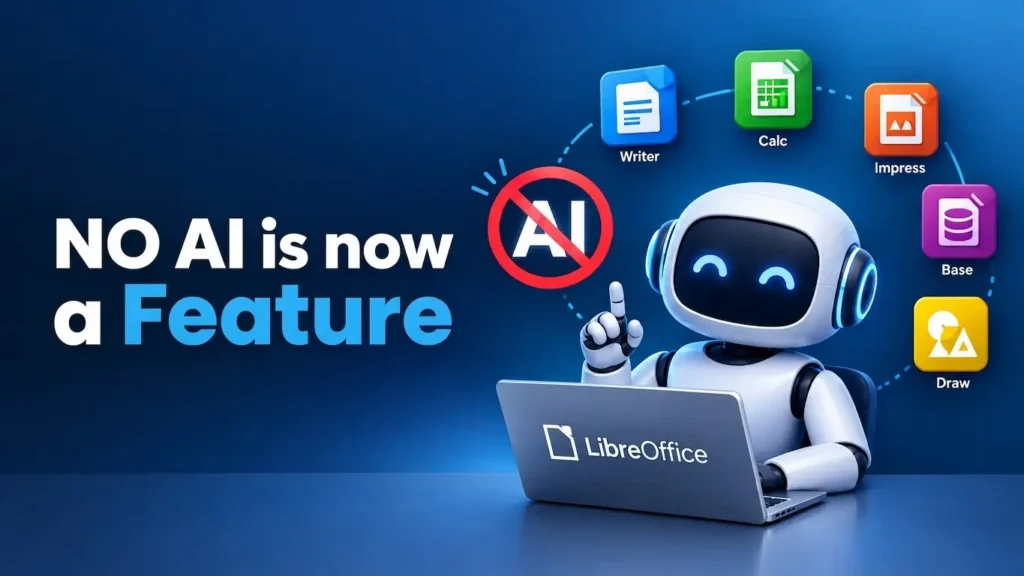
LibreOffice 26.8 did something unexpected. Among the paragraph composer, the right-to-left typography work and the chart round-tripping, the release notes carried a section of its own: no artificial intelligence. No generative AI features. No documents transmitted to remote services. No component of the suite requiring network access. Listed as a deliberate position rather than a gap.
Then the numbers came in. Over a million downloads in the first seven days, the strongest launch week in the project’s history. A day after announcing that milestone, The Document Foundation published a follow-up titled “Yes, no AI is now a feature.”
This matters because it reveals something the industry has been ignoring: users are telling us exactly what they want, and it’s not what most software companies are building.
The LibreOffice Story: When “No AI” Became a Feature Worth Marketing
Let me set the scene. The Document Foundation released LibreOffice 26.8 on September 4, 2026. The announcement led with this statement: LibreOffice 26.8 contains no generative AI features. Documents are not transmitted to remote services for processing. No component of the suite requires network access to function. This is a deliberate position.
The response was significant. The project experienced record-breaking download numbers in the first week, its strongest launch performance in history. Within weeks, adoption continued to climb across all platforms.
People didn’t download it because it’s new or flashy. They downloaded it because they were tired of being forced to use AI features they didn’t ask for.
One day after announcing the download milestone, The Document Foundation published a follow-up blog post with a title that captured the whole moment: “Yes, no AI is now a feature.”
What “No AI” Actually Means
This is where most people misunderstand the story. LibreOffice isn’t anti-AI. They’re not rejecting artificial intelligence out of hand. The Document Foundation explicitly stated that position.
What they’re actually doing is giving users complete control over AI execution.
Here’s their core principle: AI must be entirely optional, and critically, the user decides where it runs. This is the part that really matters. If you want AI in LibreOffice, you can install a third-party extension that connects to a local model via Ollama, LM Studio, or another OpenAI-compatible endpoint. Your document never leaves your computer. Your data stays yours. You control whether it happens at all, and you control exactly where the processing takes place.
If you don’t want AI? You don’t get it forced into your interface. You don’t get upsells. You don’t get telemetry. You just get your office suite.
The Document Foundation outlined five non-negotiable principles for any future AI integration:
User-Controlled Execution and Location. This is the critical one. The user must be able to choose where inference takes place: on their own local computer, on infrastructure they directly control, or on a service they independently selected. You’re not stuck with a default setting that silently redirects to a single provider. You decide if processing runs locally on your machine, on your own server, or on a cloud service of your choice. This level of control is unprecedented in mainstream office software.
Data Privacy and Sovereignty. No content may leave the computer without authorisation. The content of documents is a user’s asset and, in many implementations, is also legally protected material: medical records, case files, tender documents, student data. For regulated industries, this is non-negotiable.
No Telemetry, No Lock-In. LibreOffice does not collect usage data, and any future AI feature would follow the same rule. Provider independence is essential. An AI feature tied exclusively to a single company’s API would amount to lock-in. Any future integration would need open interfaces that work with multiple backends.
Format Preservation. AI-generated content would need to remain in OpenDocument Format and preserve document structure, styles, and semantics rather than introducing dependence on proprietary formats.
Entirely Optional. Administrators should be able to install or remove it. Users who do not want AI should not see it in the interface.
Compare this to what Microsoft is doing. Microsoft has recently foisted a floating AI icon in the corner of Word, Excel and PowerPoint that cannot be disabled. They’ve added upsells targeted at people already paying for Microsoft 365. Users can’t turn it off. They can’t negotiate. It’s mandatory, and it’s designed to eventually cost them more money. You have zero control over where your data goes or how it’s processed.
The Business Model Behind the Story
The most honest explanation came from The Document Foundation itself: their position “has almost nothing to do with the technology.”
For a company that sells subscriptions, an AI assistant justifies a price increase and strengthens the case for keeping all documents within its own infrastructure. The functionality and the business model reinforce each other. Integration becomes not just attractive but mandatory. Any executive pushing back on AI gets overruled by investors, quarterly targets, and the pressure to “innovate” with what everyone else is doing.
The Document Foundation is a not-for-profit organisation. There are no subscription tiers to protect. No upsells. No data to monetise. No quarterly earnings calls. That structural difference changes everything. They can actually answer the question: “Is this good for users?” instead of “How does this help us lock them in?”
What This Reveals About What Users Actually Want
Here’s the insight that matters: LibreOffice’s surge in adoption isn’t about users rejecting AI. It’s about users rejecting being controlled.
For organisations handling confidential data- hospitals, law firms, government agencies, financial services- this isn’t preference. It’s compliance. You need to know exactly where your data goes and where processing happens. Medical records can’t be sent to OpenAI servers. Client files can’t touch someone else’s infrastructure. Auditors won’t sign off on it. HIPAA, GDPR, and SOX compliance all demand that you maintain control over data location and processing.
But it goes deeper than regulation. There’s a broader exhaustion setting in. Users are tired of:
- Forced features they didn’t ask for. AI shouldn’t be mandatory. It should be opt-in.
- Hidden business models. Companies that use “free” to lock you in, then monetise your data or your lock-in.
- Telemetry and tracking. Software that reports everything you do back to corporate servers.
- Single-vendor dependence. Tools that force you to use one company’s infrastructure or go without.
- No visibility into where their data is processed. If AI runs somewhere, users need to know where and have the option to run it locally instead.
LibreOffice’s adoption tells us that these concerns matter enough to drive real purchasing decisions. When buyers evaluate office suites, they’re now asking: “Can we turn off AI? Can we run it on our own machines? Does it require cloud connectivity? Who owns our data? Where does processing happen?”
What This Means for Software and B2B Marketing
If you build or sell software, LibreOffice 26.8 is a case study in positioning. They didn’t beat Microsoft at its own game. They won by defining a completely different game.
For B2B SaaS companies, this shift is important:
- User control is now a selling point. In procurement conversations, especially in regulated industries, the ability to say “this is optional and you control where it runs” has become a competitive advantage.
- Transparency builds trust at scale. LibreOffice didn’t hide their stance. They explained it publicly, backed it up with principles, and proved they meant it. That honesty creates loyalty.
- “No forced AI” is a real purchase criterion. When Deloitte or NHS or any enterprise legal team is evaluating tools, they’re asking: can we turn it off? Can we run it locally? If your answer is no, you lose the deal.
Why This Excites Me as an Open Source Marketer
I’ve built much of my career around open source tools. When I build marketing stacks, I choose Mautic over HubSpot when privacy and control matter. I run Nextcloud on my own infrastructure instead of relying on Dropbox. I’ve spent years arguing that open source isn’t a compromise; it’s a competitive advantage.
But here’s the thing that makes LibreOffice’s moment significant: open source is no longer niche. It’s no longer just for developers and privacy nerds. A not-for-profit office suite just achieved record-breaking adoption by positioning user control as a feature, and millions of mainstream users responded.
That’s a massive shift. It means the market is ready for open source principles, not as a cult belief, but as a practical business requirement. When enterprises ask “can we turn off AI” and “can we run it locally on our own servers,” they’re asking for open source thinking, whether they call it that or not.
This is exactly what I’ve been tracking in my B2B marketing work. Buyers are starting to factor in control, ownership, and transparency as real purchasing criteria. Open source tools have always offered these things. Now, mainstream software is finally playing catch-up.
LibreOffice’s marketing brilliance wasn’t inventing something new. It was packaging what open source has always stood for into messaging that resonates at scale. As you can see in discussions around this trend, users are genuinely tired of the “move fast and break privacy” approach. They want tools that respect their autonomy and data sovereignty. That’s worth learning from.
The Larger Shift
What we’re seeing emerge is a backlash against the “AI-for-everything” era. Not against AI itself, but against the assumption that every product must have AI, that users will accept it being mandatory, that they have no choice about where processing happens, and that companies can force adoption to justify price increases.
Users are telling us: we want tools that work for us, not against us. We want control. We want to know where our data goes and where it’s processed. We want optional features, not mandatory ones. We want the ability to run AI locally on our own infrastructure if we choose to use it at all. We want transparency about business models, not dark patterns and hidden upsells.
LibreOffice’s record-breaking adoption is the market responding to that signal.
The Takeaway
“No AI” isn’t becoming a feature because users hate artificial intelligence. It’s becoming a feature because users are reclaiming control over their tools. They want to decide whether to use AI, how to use it, where it runs, and who has access to their data. They want transparency about who benefits from their data. They want tools designed for their needs, not their vendor’s quarterly earnings.
This is what the market is actually telling us. And the companies that listen to this signal, that put users first instead of business model second, and that give users genuine control over where AI processing happens, are the ones who will win the next wave of software adoption.
For open source advocates, this moment is vindication. For everyone else, it’s a wake-up call.
If you want to know more about how I’ve built my entire marketing stack on open-source tools and Linux, I’ve documented my full setup in detail here: https://blogs.findingcities.in/linux-for-marketing