For years, the B2B SaaS growth playbook was simple: rank for the keywords your buyers search, drive them to your site, and convert that traffic into pipeline. That logic worked because buyers followed a predictable path: search query, click, landing page, form fill.
That path doesn’t hold anymore.
Buyers Have Already Moved On
Half of B2B software buyers now say they start their research inside an AI chatbot instead of Google, and that number jumped sharply in just a few months, according to G2’s survey of over 1,000 software buyers. Eighty-seven percent of those buyers say AI chatbots are actively changing how they evaluate vendors. ChatGPT remains the clear favorite, used roughly three times more than any other model.
Meanwhile, the traditional search results page is quietly dying as a traffic source. Industry tracking shows organic click-through rates fall by around 70% whenever an AI Overview appears above the results, and more than 60% of all Google searches now end without a single click. Impressions can climb while actual visits to your site decline, a trap for any team still measuring success by rankings and traffic alone.
The takeaway is blunt: your buyers are forming opinions about vendors before they ever reach your website, inside an AI conversation you don’t control.
Ranking vs. Being the Answer
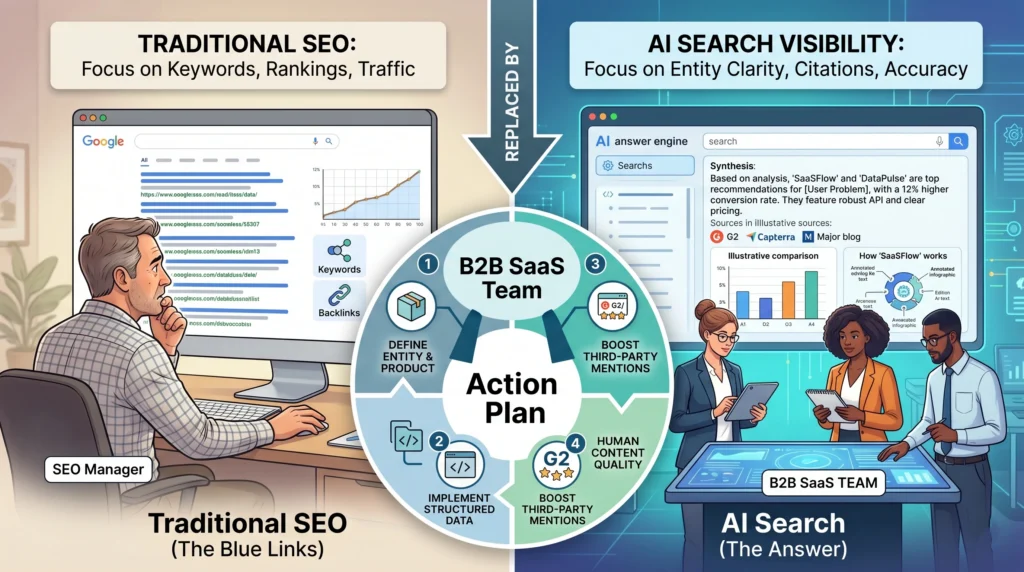
Traditional SEO and AI search reward fundamentally different things. SEO gets you a position in a list of blue links the buyer still has to click through. AI search engines like ChatGPT, Perplexity, and Google’s AI Overviews skip the list entirely. They synthesize an answer and name specific vendors directly. If your brand isn’t one of the names mentioned, you’re invisible at the exact moment criteria and shortlists are being formed.
This shift has a name: Answer Engine Optimization (AEO), sometimes also called Generative Engine Optimization (GEO). The goal isn’t to rank. It’s to be cited.
Why This Matters More for SaaS Specifically
SaaS buying involves long sales cycles, multiple stakeholders, and high perceived risk, which makes AI-mediated research especially influential. Buyers increasingly use AI tools for comparison and validation questions, exactly the “tell me what to pick” queries chat interfaces handle well. Being mentioned as a trusted option, even without a click, shapes the shortlist long before a sales conversation starts.
There’s a financial case too. Average customer acquisition cost for B2B SaaS has climbed sharply over the past several years, and that pressure intensifies as organic search performance declines and reliance on paid channels grows. Teams that get cited in AI answers report meaningfully higher brand mention volume than those who don’t.
What to Actually Do About It
The good news: none of this requires throwing out your existing SEO work. AI search visibility builds on technical SEO fundamentals rather than replacing them. Here’s where to focus:
1. Write for the question, not the keyword. AI tools respond to long, specific, conversational queries, such as “what’s the best [category] tool for a mid-size [industry] company with [constraint],” rather than short high-volume keywords. Structure content around the actual questions your buyers ask, and lead with a direct answer in the first few sentences before adding context.
2. Make your content extractable. AI systems pull and summarize content in chunks. Use clear headers, FAQ sections with schema markup, comparison tables, and an inverted-pyramid structure: answer first, detail after. Listicle-style formats get cited noticeably more often than standard blog or opinion posts.
3. Build topical depth, not just page count. AI systems map how comprehensively a brand covers a subject across an entire site, not just whether one article ranks. Interlinked topic clusters signal authority more effectively than isolated posts targeting individual keywords.
4. Earn mentions beyond your own website. LLMs draw conclusions from the wider web. Review sites like G2 and Capterra, press coverage, founder quotes, podcast appearances, and LinkedIn activity all feed into how confidently an AI system references your brand. If you’re only described on your own site, there’s little for an AI model to corroborate.
5. Add structured data. Most B2B SaaS sites still have no schema markup at all, which makes it a low-effort, high-leverage fix. Adding SoftwareApplication and FAQPage schema gives AI crawlers a machine-readable signal of what your content covers.
6. Track mentions, not just rankings. Run a representative set of buyer queries through ChatGPT, Perplexity, and Gemini regularly, and track whether and how your brand shows up. Note which competitors appear in answers you don’t; that gap is your next content priority. Visibility in AI answers tends to show up before any traffic change does, so don’t wait for analytics to confirm the shift is real.
The Bottom Line
SEO isn’t dead, but it’s no longer sufficient on its own. The buyers researching your category today are increasingly forming their first impression of your product inside a conversation with an AI assistant, one that names names. Teams that adapt their content strategy now, before competitors catch on, are building a visibility advantage that compounds. Teams that wait are optimizing for a search experience that fewer and fewer buyers are actually using.