Matomo vs Google Analytics 4 isn’t about finding the better tool. It comes down to which problem you have. I set up GA4 and Google Tag Manager for B2B clients (the setups I actually use are here), and I also like running my own tools on my own servers, so clients ask me this a lot. This is the comparison I give them, including the cases where GA4 is still the sensible choice.
The short answer: choose GA4 when the client spends real money on Google Ads and wants no server to maintain. Choose Matomo when data ownership, consent control or where the data is stored is a non-negotiable requirement, or when you want your analytics sitting in your own database. For many B2B sites, running both for a month before committing is the safest move.
Want help getting your analytics set up properly?
If you want your analytics set up properly for B2B lead generation, whether that is GA4, Matomo or both, I am happy to talk it through.
Email me Know more about meMatomo vs GA4 at a glance
| Matomo | Google Analytics 4 | |
|---|---|---|
| Data ownership | You, when self-hosted | Google stores and processes it |
| Cost | Free to self-host, you pay for the server. Cloud plans are priced by monthly traffic and start at about 29 euros a month | Free for standard use |
| Data retention | You decide when self-hosted | 2 or 14 months for event data in standard properties |
| Sampling | None when self-hosted | Thresholds or sampling apply in some reports |
| Consent | Cookieless mode available, so some setups need less consent handling. Check your own legal position | Needs consent handling in regions that require it |
| Google Ads link | No native link, you upload conversions yourself | Native link, audiences and conversion import |
| Tag manager | Matomo Tag Manager | Google Tag Manager |
| Heatmaps and recordings | Available as add-ons (check which are paid) | Not included |
| Setup effort | Self-hosted: PHP, a database, updates, backups. Cloud: low | Low |
Data ownership and where your data lives
With self-hosted Matomo, the data sits on your server, and Matomo says it has no way to access data hosted that way. With GA4, Google stores and processes everything. For most small B2B sites that difference is academic. It becomes a real issue for regulated clients, clients with data residency rules, and anyone who wants raw visit data in their own database to join with CRM records.
Consent and privacy
This isn’t legal advice, so check the rules in the countries your visitors are in. In practice, GA4 generally needs consent handling wherever the law requires it, and when visitors decline you lose that data. Matomo can run in a cookieless or anonymised mode, and some setups face less consent friction, but whether that is enough depends on your country and your legal advice. For a UAE company selling to UK or EU buyers, don’t assume one answer fits every visitor.
The point most people miss is that the consent banner hurts the data in both tools. If half your visitors reject cookies, neither tool sees them properly. Cookieless options reduce the damage. They don’t remove it.
Accuracy: why the numbers never match
Run both tools side by side and the totals will differ. That is expected. Session definitions differ, bot filtering differs, consent gaps differ, ad blockers hit each tool differently, and GA4 applies thresholds in some reports. A self-hosted Matomo served from your own domain may be blocked less often than a Google script, but it is not immune.
So compare trends, not totals. Does a campaign spike show up in both? Do the same pages lead in both?
Ad platform integration
This is where GA4 is hard to beat. If a B2B client spends meaningfully on Google Ads, the native link gives you audiences and conversion import with very little work. With Matomo you can still measure campaigns through UTM tagging, but sending conversions back to Google Ads becomes a job you do yourself, usually by uploading offline conversions from your CRM. Neither tool replaces the pixels and server-side events that Meta and LinkedIn want for their own optimisation.
Reporting and learning curve
GA4 treats every interaction as an event. That is flexible, but it confuses people used to pageviews and sessions. It fits well if your team already works in Looker Studio or with BigQuery exports. Matomo mixes pageviews and events in a way that feels closer to older analytics tools, so non-technical clients tend to find its standard reports easier to read. If you self-host, Matomo also gives you direct access to your own data.
If you stay on GA4 and want AI to help with the reporting, I wrote up how I connected it in my post on the Google Analytics MCP server.
Running Matomo yourself: the real work
Self-hosting has no licence fee, but it is not free in effort. You need PHP and a database, a scheduled job to process reports on larger sites, regular updates, backups, and protection against referrer spam. If that list sounds like a chore, Matomo Cloud removes it for a monthly fee.
What I would choose for a B2B client
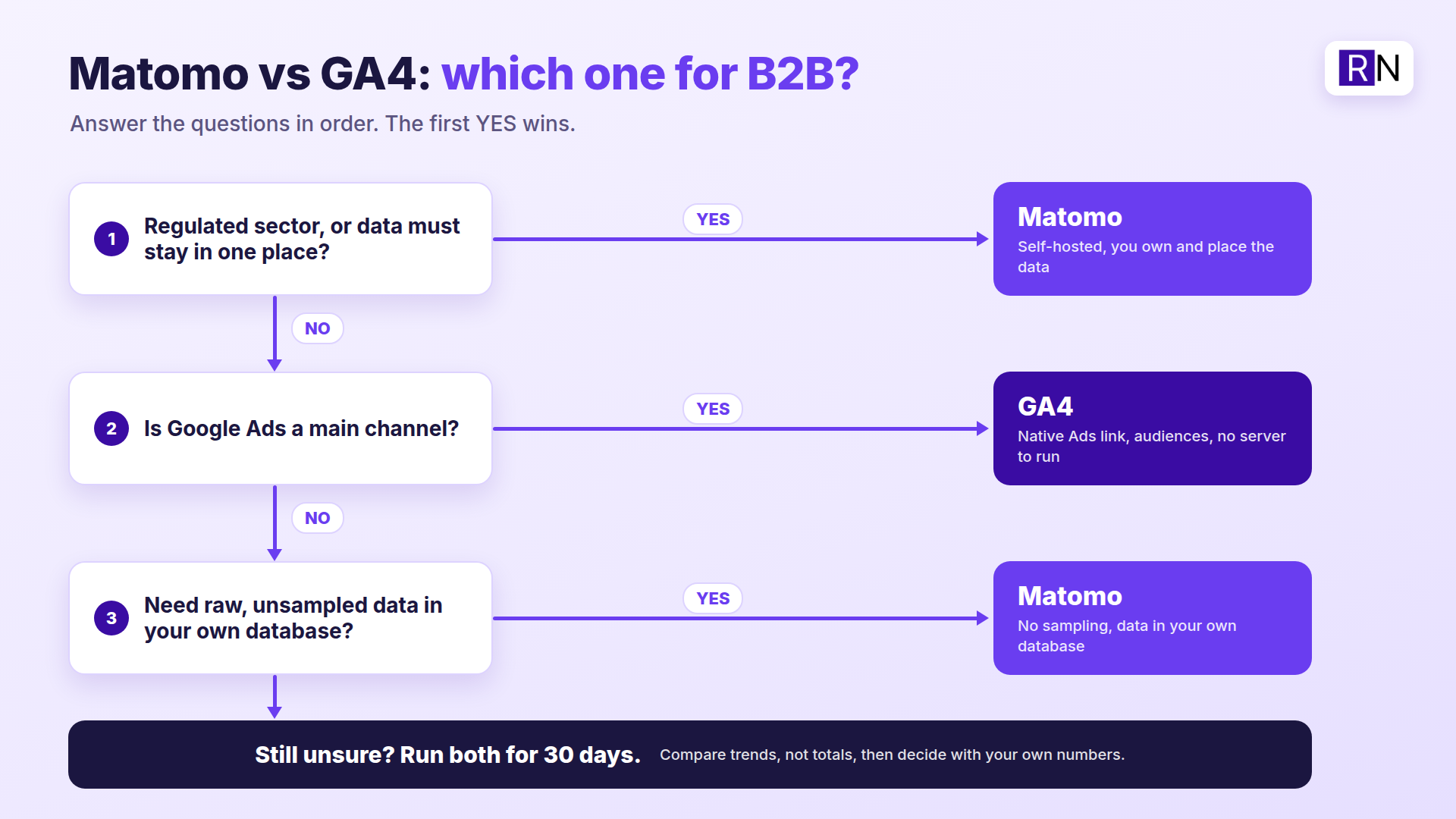
Matomo when the client is in a regulated sector, needs data stored in a specific place, wants unsampled data in their own database, or runs several small sites that can share one install.
GA4 when Google Ads is a main channel, the client wants no maintenance, the team already uses Looker Studio or BigQuery, and nobody is pushing on data location.
Both when you are unsure. Run them side by side for 30 days, compare trends, and decide with your own numbers.
Mistakes to avoid
- Switching with no parallel run, then finding your new reports have no history to compare against.
- Expecting identical totals in both tools.
- Forgetting that Google Ads links and imported conversions stop working when you drop GA4.
- Treating cookieless mode as a reason to skip legal review.
- Self-hosting without a backup and update routine.
FAQ
Is Matomo better than Google Analytics 4?
Neither wins on every point. Matomo gives you more control over data ownership and privacy. GA4 is stronger on Google Ads integration and needs no server. The right pick depends on your client’s priorities.
Is Matomo free?
The self-hosted version costs nothing to use; you pay for the server and your own time. Matomo Cloud is a paid plan priced by monthly traffic, so check the vendor’s current pricing.
Does Matomo work without a cookie banner?
In some setups, such as cookieless mode with anonymised IPs, it can reduce or remove the need for consent in some places. Rules differ by country, so get legal advice for yours.
Can Matomo replace GA4 for Google Ads?
Not easily. You can measure traffic from campaigns, but audiences and automatic conversion import come from the native GA4 link. With Matomo you upload conversions yourself.
Can I run Matomo and GA4 together?
Yes, and it is the safest way to migrate. Run both for about a month, watch the trends, and switch only when you trust the new numbers.
Does Matomo have a tag manager?
Yes. Matomo Tag Manager is the equivalent of Google Tag Manager.
Sources: Matomo pricing and Google’s GA4 data retention documentation. Check both for current figures.